
UX Research · Mixed Methods · Service DESIGN · Concept Testing · Individual Contributor (IC)
Validating Future-State Digital Branch Experiences at CIBC
Digital check-in might sound like a simple enough concept; until it simultaneously has to work for walk-in clients, booked appointments, busy branches, anxious customers, older clients, newcomers, frontline staff, private advisor meetings, late arrivals, transaction queues… you get the point.
At CIBC, I led mixed-methods concept validation research to understand how future-state digital branch "enhancements" being proposed by the business would be perceived by Canadian banking customers and frontline staff across several key branch journeys.
The core question was not simply: Do people like the digital enhancement concepts?
It was:
When might the digital branch enhancements genuinely help; and when might they actually become just another layer of friction?
THE CORE QUESTION
When might the digital branch enhancements genuinely help; and when might they actually become just another layer of friction?
Before arrival
Check in
Queue & wait
Human support
PROJECT SNAPSHOT
A mixed-methods study grounded in branch reality.
ROLE
UX Research Lead
ORGANIZATION
Canadian Imperial Bank of Commerce (CIBC)
METHODS
Quantitative survey, unmoderated customer interviews, moderated frontline interviews
PARTICIPANTS - 294 total
267 customers surveyed · 20 unmoderated customer interviews · 7 frontline staff
SCOPE
4 branch visit scenarios · 3 future-state digital enhancement concepts
OUTPUTS
Research report · executive summary · stakeholder readout · UXR recommendations
THE CHALLENGE
Branch experiences are physical, emotional, operational, and highly situational.
The team was exploring digital enhancements intended to improve how clients are guided, served, and supported in the branch.
The research focused on 3 proposed enhancements:
Digital check-in: A digital entry point for clients to confirm arrival, join a digital queue before arrival, identify their reason for visiting, view wait times, etc.
In-branch virtual advisor coordination: A way to connect clients with an advisor from another branch when no in-person advisor is available.
Real-time feedback: A lightweight way for clients to share feedback shortly after a branch visit.
But the same feature could feel helpful in one context and unnecessary, confusing, or even unfair in another. The research needed to clarify not only whether clients liked the concepts, but what conditions would need to be true for them to work in a real branch environment.
“
The same digital tool could be helpful, redundant, or risky depending on the branch journey.
MY ROLE
Research Lead, end to end: I led the research planning, study design, frontline interviews, synthesis, reporting, and stakeholder readouts.
A key part of my role was framing the work around realistic branch journeys rather than evaluating each enhancement as an isolated feature.

UXR Responsibilities
01
Structuring the research around four branch scenarios
02
Supporting mixed-methods study design and data synthesis
03
Conducting moderated interviews with frontline staff
05
Creating the final research report and readout materials
06
Presenting findings and recommendations to stakeholders
THE FRAMING DECISION: The 4 Journeys
Journey context first.
One of the most important research decisions was to structure the study around branch visit scenarios rather than around individual features. If we had only asked people whether they liked “digital check-in,” we would have missed the point. Digital check-in does not mean the same thing in every journey. Framing the study around four realistic branch visits shifted the work from feature validation to service experience validation. It let us understand where the concepts created value, and where they introduced risk.
RESEARCH APPROACH + Execution
Mixed methods, across customers and frontline staff.
Quantitative customer survey
267 Canadian banking customers completed scenario-based concept evaluation across the four branch journeys.
Qualitative customer interviews
20 unmoderated video interviews: 10 focused on transaction journeys and 10 on advice journeys.
Frontline staff interviews
7 moderated 1:1 interviews with Frontline staff focused on workflow, handoffs, fairness, and service ownership.
Important sample caveat: customer participants skewed digitally comfortable because they were recruited through a digital research platform. I treated this as an important lens throughout the analysis. If a digitally comfortable sample group still showed strong interest in staff-assisted options, privacy concerns, and resistance to digital-only paths, those concerns would likely be even more pronounced among less digitally comfortable clients.
AI-Assisted Research Activities
Using AI as a research partner, not a substitute for judgment.
I used AI throughout the project to accelerate understanding, challenge my thinking, and turn dense research evidence into clearer stakeholder-facing communication. AI supported the process; interpretation, prioritization, and final recommendations remained human-led.

01
Context + thinking partner
I fed AI project context through meeting transcripts and my own recorded monologues, then used it to ask questions, brainstorm, pressure-test ideas, and work through ambiguity.
02
Early theme orientation
Before beginning my manual review, I used AI-generated transcript themes and Maze’s automated thematic analysis to get an early read on recurring patterns and areas worth watching during synthesis.
03
Human + AI cross-checking
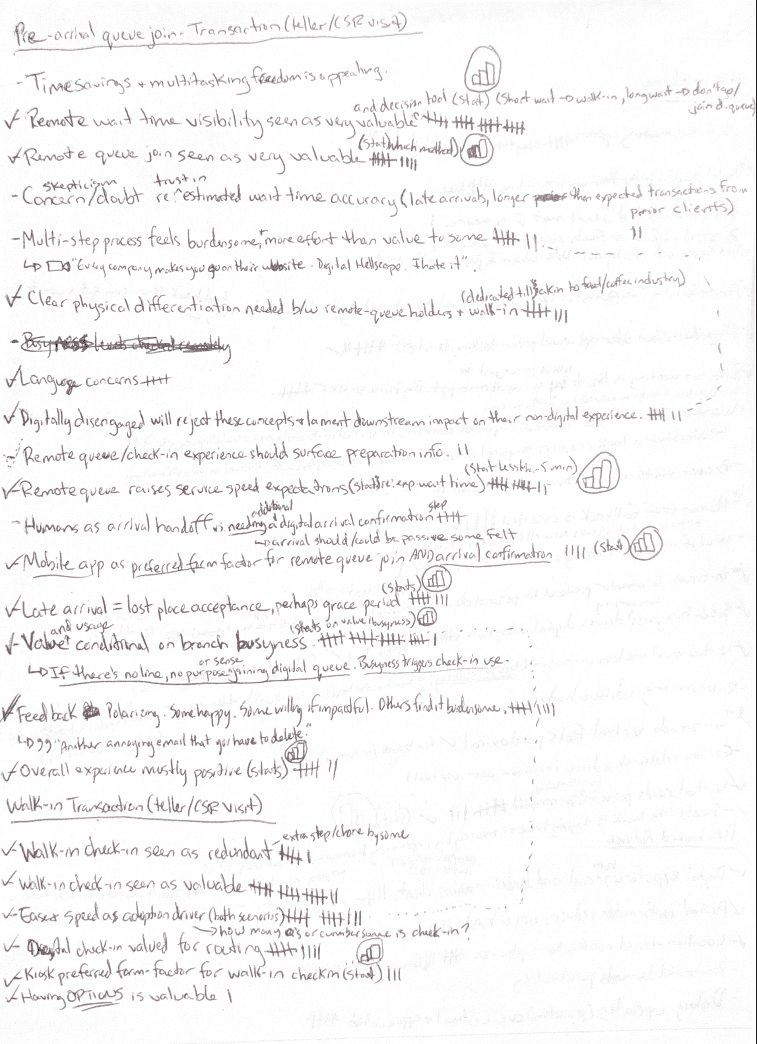
I manually tracked themes and frequency across interviews, then compared those patterns against AI-generated themes to identify alignment, gaps, and findings that warranted a closer look.
04
From messy notes to clear findings
I uploaded photos of handwritten interview synthesis notes — including frequency tallies and notes marked for discretionary importance — and used AI to convert my raw, dense findings, notes, and ideas into clear stakeholder-facing language.
05
Reporting support
AI helped me refine theme summaries, organize supporting evidence, and shape report language, while I retained final judgment over which findings mattered, how strongly they should be stated, and what recommendations followed.
06
Context-informed visuals
I used image generation to create contextual visuals for research reporting where custom imagery helped communicate concepts more clearly.
Scroll AI Activities →
01—06
SYNTHESIS
Turning a dense study into a clear story.
This was not a small, tidy usability test. The study generated a large volume of evidence across multiple scenarios, methods, and audiences. I reviewed customer recordings by journey and question, tracked recurring patterns, and relied on both frequency of themes as well as my own discretionary judgement to prioritize the significance of findings and insights. And as detailed earlier, I also compared my synthesis against Maze’s AI-generated thematic analysis. The final synthesis brought together quantitative survey results, qualitative customer video responses, frontline staff interview findings, and AI-assisted theme exploration, into a narrative stakeholders could act on.
WHAT WE LEARNED
Featured UXR insights.
92%
rated remote visibility of branch wait times or busyness as valuable to very valuable before deciding whether to join a queue remotely.
79%
expected to be seen within 10 minutes after arriving from a remotely joined digital queue; 38% of which expected under 5 minutes.
60%
would take an immediate in-branch virtual advisor meeting if no in-person advisor was free, and 69% want it in a fully private room.
Preffered CHANNEL AND FORM FACTOR
The strongest direction was not one winning form factor. It was optionality.
Mobile banking app
Best when the journey begins remotely and the client wants familiar, fast planning in hand.
In-branch kiosk
A natural fit when clients arrive without beginning on their phone, or prefer a branch device.
Speaking with staff
An essential path for complex needs, language support, accessibility, and moments when digital triage fails.
More Insights
01
Digital adoption was conditional
Digital tools were welcome when they avoided a line, saved time, reduced uncertainty, or prevented misdirection — not simply because they were digital.
02
Wait-time visibility had standalone value
Wait information supported planning: go now, choose another branch, wait until later, join remotely, or skip the trip.
03
Remote queueing raised the service promise
Giving clients time back also creates an expectation of a short, realistic in-branch wait after arrival.
04
Virtual advisors worked as a fallback
The concept was credible only as a private, reliable, branch-capable alternative when in-person availability was limited.
05
Arrival confirmation reduced uncertainty
For booked advice visits, mutual awareness made an uncertain waiting moment feel organized and acknowledged.
06
Categorization was a service dependency
Incorrect categories can create wrong routing, inaccurate waits, manual recovery, and client frustration.
07
A digital queue cannot exist only on a screen
The hybrid line needs visible physical rules, service points, waiting spaces, and fair handoffs.
08
Accessibility was an opportunity and a risk
The same tool can reduce social friction for one client and create a barrier for another; optionality matters.
Scroll more insights →
01—08
THE SERVICE DESIGN LAYER
A digital branch experience is only partly digital.
This research was not just about screens, buttons, or form factor preference.
Although this was a UX research study, many of the findings had service design implications. It examined how digital touchpoints would interact with staff roles, physical branch spaces, client expectations, operational rules, etc. While the "enhancements" were digital, there is no doubt this research was evaluating systems concepts for an end-to-end service experience with significant downstream impact on the branch operating model.
Check wait time → Join queue → Check in → Confirm arrival → Meet with advisor → Provide feedback
Staff greeting → Lobby flow → Queue visibility → Advisor notification → Private room setup → Client handoff
Service categorization → Wait-time logic → Late-arrival rules → Staff ownership → Room availability → Language support
Service Design Takeaway
A digital branch experience cannot be designed as only an app flow. It requires a matching branch operating model, physical waiting experience, and staff handoff model.
RECOMMENDATIONS
The final report translated the findings into UXR recommendations for product and service development:
01
Keep digital experiences optional
Preserve human-assisted paths for less digitally comfortable clients, complex needs, language constraints, and failed digital triage.
02
Treat wait-time visibility as standalone value
Support pre-visit planning, branch selection, expectation-setting, remote joining, and direct walk-ins.
03
Investigate service categorization
Test how clients describe banking needs before relying on categories for routing, wait logic, or appointment intent.
04
Define the hybrid line system
Make digital and traditional paths visibly fair through clear arrival, waiting, service-point, and calling rules.
05
Make virtual meetings branch-capable
Support private rooms, reliable technology, verification, signatures, documents, language needs, and room availability.
06
Clarify human fallback ownership
Define who supports check-in, technical recovery, virtual-room issues, and complex client situations.
07
Define late-arrival and fairness rules
Establish timing, grace periods, place-loss logic, updates, and protection for on-time clients.
08
Pilot across branch types and client populations
Test varied demographics, traffic patterns, physical layouts, staffing models, language needs, and digital comfort.
Scroll the recommendations →
01—08
STAKEHOLDER COMMUNICATION AND IMPACT
From “Do people like these ideas?” to “What conditions need to be true for them to work?”
The detailed readout and executive summary were designed to do more than simply recap findings. They were open conversations that helped stakeholders understand which concepts were promising, what caveats mattered, and where the team needed to think more carefully before implementation. Several stakeholder discussions emerged during the readouts regarding service categorization, queue fairness, physical branch infrastructure, variable branch environments and clientele, digital and traditional line coexistence, among other meaningful considerations.
One important moment came when a key, senior stakeholder summarized the UXR findings by stating that "overall, it seems there's nothing about the proposed concepts that clients would take significant issue with."
I clarified the nuance: the concepts were generally well received by a sample group that skewed digitally comfortable, and yet still a small, but passionate, minority reacted strongly against digital-first experiences, especially when they felt technology was replacing human service or making traditional paths worse.
That distinction mattered.
What the work helped the team do
Understand how digital check-in value changes by branch journey
Identify branch busyness and time savings as major adoption drivers
Recognize remote wait-time visibility as a valuable planning feature
Clarify the privacy and service requirements for in-branch virtual advisor meetings
Surface operational risks around service categorization, late arrivals, queue fairness, and human fallback ownership
Connect customer preferences with frontline workflow realities
Frame recommendations for further research, piloting, and service model definition
Reflection
The research question is rarely just the question you’re handed.
One of my biggest takeaways from this project was the importance of challenging the initial framing of a research ask. I was brought in to evaluate a set of proposed digital enhancements, but simply asking whether clients liked them would not have given the team what they actually needed.
The more useful question became: under what conditions and within which journeys do these experiences create value, and when might they introduce new friction or operational challenges? That reframing shaped the study design, the scenarios I evaluated, and the decision to look at the experience through both customer and frontline perspectives.
This was also the most extensively I had used AI within a large research study. It reinforced for me that AI can dramatically accelerate sensemaking, exploration, and communication, but it also makes researcher judgment even more important. By spending time immersed in the interviews, notes, patterns, contradictions, and edge cases, I developed a depth of understanding that allowed me to interrogate AI-generated themes rather than simply accept them.
UXR Process Takeaway
The value of research is not only what you learn. It is becoming close enough to the evidence to understand what it really means, then helping the team understand that nuance clearly enough to decide what to do next.